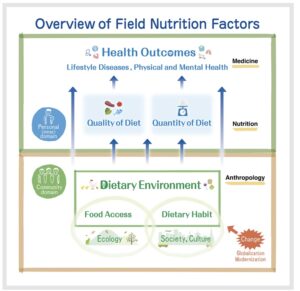
「食べる」という営みは、単に必要な栄養素の摂取だけでなく、その食習慣の基盤となる環境因子(自然環境、社会環境)や文化的背景と深く関わります。フィールド栄養学では、食と健康との関連を分析する疫学調査を軸に、その食行動の背景をフィールドワークによって探究します。国内外の地域において比較研究を行うことで、食と健康との関連における地域特性を理解し、地域に応じた「食からのアプローチ」を通した健康課題の解決を目指します。
フィールド栄養学での調査方法は、食事調査(食事の「量」と「質」の評価)とともに、集団の健康状態を把握する健診などの量的調査、さらに、地域の特性を探求するフィールドワーク(観察調査やインタビュー調査など)を組み合わせて行います。食事調査では、基本的な栄養アセスメントとともに、フィールドでも簡易に食事摂取の「質」を把握することができる「京都式食多様性スコア11-item Food Diversity Score Kyoto (FDSK-11)」*を用いています。
Eating is not just about the intake of essential nutrients but is deeply connected to the environmental factors (natural and social environments) and cultural background that form the foundation of dietary habits. In Field Nutrition, we analyze the relationship between food and health through Epidemiological studies and explore the underlying factors of dietary behaviors through fieldwork. By conducting comparative research in several regions in Asian countries, we aim to understand the local characteristics in the relationship between diet and health and address health issues through region-specific approaches.
In Field Nutrition, research methods combine dietary assessments (evaluating both the "quantity" and "quality" of food intake), quantitative surveys such as health checkups to assess the overall health status of the population, and fieldwork (including observational studies and qualitative interviews) to explore the specific characteristics of each field. In dietary assessments, alongside basic nutritional evaluations, we often use the 11-item Food Diversity Score Kyoto (FDSK-11), a tool that allows easy evaluation of the "quality" of dietary intake in the field.
*京都式食多様性スコア(FDSK-11) は、フィールドでも簡易に使えるように考案された、食品摂取頻度を問う質問票です。11食品群の一週間の摂取頻度を4択で問いスコア化することで、どれだけ多様な食品を摂取できているかという「食事の質」を評価します。
>> 京都式食多様性スコアの質問票をご利用になりたい方は、ProfileページのContact にご連絡ください。
*11-item Food Diversity Score Kyoto (FDSK-11):
A simple screening tool to evaluate “dietary quality” by answering a questionnaire on the frequency of food intake from 11 food groups over one week. This questionnaire was developed to easily assess nutritional intake in the field, without complex measurements or difficult recall questions, especially useful when interviewing the older adults.
If you are interested, please contact us via the “Contact” section on the profile page. (English, Spanish, Thai, and Chinese versions are available.)
References 参考文献
- Kimura Y, Wada T, Ishine M, et al. (2008) “Food diversity is closely associated with activities of daily living, depression, and quality of life in community-dwelling elderly people.” J Am Geriatr Soc. 57, 922-924.
- Kimura Y, Okumiya K, Sakamoto R, et al. (2009) “Comprehensive geriatric assessment of elderly highlanders in Qinghai, China IV: comparison of food diversity and its relation to health of Han and Tibetan elderly.” Geriatr Gerontol Int. 9,359-365.
- Kimura Y, Wada T, Okumiya K, Ishimoto Y, Matsubayashi K, et al. (2012) ‘‘ Eating alone among community-dwelling Japanese elderly: association with depression and food diversity.” J Nutr Health Aging. 16(8), pp.728-31.
- 木村友美(2026)「フィールド栄養学―世界の食と健康に挑む」大阪大学出版会